
 What Does Moscow Need It for and What Might Be the Consequences
Ivan Sichen
A new and extremely threatening factor in the Russian-Ukrainian war and in the confrontation between Moscow and the West are the Russians’ intentions to deploy nuclear weapons on the territory of Belarus. In fact, this shows that the world does plunge into the Cold War between democratic and totalitarian systems. Of course, there may be a nuclear conflict “concerted” by the Putin regime if there is a real prospect of Russia’s losing its dominance and disintegrating or losing its controlled territories (including those seized from other countries). By the way, this is not only enshrined in the military doctrine of the Russian Federation, but is repeatedly confirmed by it in practice. And what is the key thing here: there is a real danger of Russia’s nuclear strike on Ukraine. Let’s hope it doesn’t come to that. But, the degree of Moscow’s hatred of Ukraine can allow all, even the most dangerous “nuclear” options.
|
…The winter-spring offensive of the Russians, which began two months ago, actually did not reach its goal… |
According to most experts, the winter-spring offensive of the Russians, which began two months ago, actually did not reach its goal. At this, Russia mostly spent the resources that it accumulated during the partial mobilization. Currently, a new stage of conscription has begun in Russia, disguised as recruiting contractors. All in all, by the end of this year it is planned to additionally gain at least 400 thousand military.
|
…Russia can still wage war against Ukraine, but by no means is capable of countering the USA and NATO as an equal with the use of conventional weapons… |
Perhaps they will manage to do this. After all, there are still enough people who want to become “cannon fodder” in Russia. However, there is practically nothing to arm them with, except for AK machine guns . It got to the point that the T-54 and T-55 tanks of the 1950s–1970s are being removed from the long-term storages. Because Russians are short even of T-62 tanks. Not to mention aircrafts, helicopters, missiles and artillery systems and the same ammunition… Russia can still wage war against Ukraine, but by no means is capable of countering the USA and NATO as an equal with the use of conventional weapons. Especially if we keep in mind the Alliance’s plans to increase the number of its troops in Central and Eastern Europe and the Baltic States by 300 thousand, as well as the obvious superiority of the tactical and technical characteristics of Western weapons over Russian ones.
|
…As a result, Moscow’s only effective means to implement its neo-imperial plans remains nuclear weapons. It is in this context that the Kremlin’s intentions to deploy nuclear weapons in Belarus should be perceived… |
As a result, Moscow’s only effective means to implement its neo-imperial plans remains nuclear weapons. It is in this context that the Kremlin’s intentions to deploy nuclear weapons in Belarus should be perceived. In this way, Russia is trying to achieve a number of important goals at the strategic and tactical levels:
Firstly, Moscow’s declarations on intentions to deploy nuclear weapons in Belarus are another element of blackmailing the USA and NATO. In this way, Russia wants to force its opponents to concede both in the sphere of Russian strategic interests and in the issue of stopping the provision of military-technical assistance to Ukraine.
Secondly, the Kremlin demonstrates that Belarus is in the Russian Federation’s “sphere of exclusive influence” and is even “an integral part of it”. This is extremely needed as a confirmation of “success in the implementation of plans for the expansion of the Russian world”.
Thirdly, Moscow demonstrates the “effectiveness” of the CSTO as an alternative to NATO and the main Russian integration structure in the post-Soviet space. Since all members of the CSTO refuse to directly participate in such military adventures, the Kremlin is trying to involve them in the implementation of its geopolitical plans. At least, in relation to Belarus with its self-proclaimed power, which completely depends on Russia, and in fact, on V. Putin himself.
Fourthly, within the framework of the Kremlin’s common policy against the West, the Russian military command is trying to bring the carriers of tactical nuclear weapons closer to the borders with NATO. This can be done without Belarus, in particular, in the Kaliningrad region of the Russian Federation, where the Iskander operational-tactical complexes are already deployed, as well as aircrafts and warships that can use tactical nuclear weapons. However, the deployment of such systems on Belarusian territory (with the exception of warships) will significantly expand the Russians’ ability to pose nuclear threats to Europe, primarily Poland and Germany.
Fifthly, combat patrols of mobile complexes of the Strategic Missile Forces (RVSN) of the RF Armed Forces may begin on the territory of Belarus. This will not give Russia much advantage, but will have a rather powerful symbolic meaning. Currently, no one allows such a prospect, although it is quite real.
|
…Technically, Russia can deploy nuclear weapons in Belarus. Since Soviet times, there have been several storage facilities where it was once stored… |
Technically, Russia can deploy nuclear weapons in Belarus. Since Soviet times, there have been several storage facilities where it was once stored, in particular, the arsenals of the RVSN Gomel-30 (missile warheads) and Machulyshchi (air bombs). There were also 1180 tactical nuclear munitions in army depots.
At the same time, several units of the RVSN were deployed in Belarus, including: in Gomel region — the 33rd Missile Division (HQ in Mozyr) of the 43rd Army of the RVSN; in Brest region — the 31st Missile Division (HQ in Pinsk), in Vitebsk region — the 32nd Missile Division (HQ in Postavy), in Grodno region — the 49th Missile Division (HQ in Lida) of the 50th Missile Army.
Already by that time, they were armed with mobile missile systems that went on combat patrols. That is, all important routes are known and tested practically. Therefore, the resumption of such a practice will not pose any problem. Unless with “adjustment” to new types of missile systems. Forty years ago, such systems were automatically aimed at targets while driving.
And at the Machulyshchi airfield near Minsk, the 121st Heavy Bomber Aviation Regiment with strategic Tu-95 strategic bombers was based. Now it is there that Russian aviation is deployed, striking Ukraine. Tu-95 bombers are also carriers of tactical nuclear weapons.
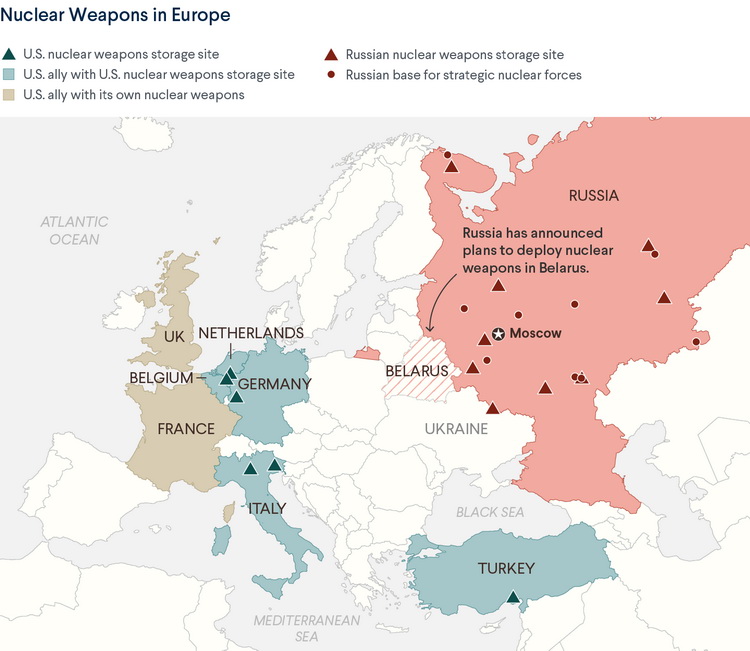 Source: The Council on Foreign Relations (CFR)
|
…At the same time, the deployment of Russian nuclear weapons in Belarus will inevitably create a number of new problems for the “allies”. At this, even greater ones than they already have… |
At the same time, the deployment of Russian nuclear weapons in Belarus will inevitably create a number of new problems for the “allies”. At this, even greater ones than they already have. First of all, such problems will be additional sanctions, which have already been promised by the United States and leading European countries to both Moscow and Minsk. For Russia, this is Europe’s final abandonment of its energy carriers, and for Belarus — a complete blocking of exports of its potash fertilizers. In this way, both economies will suffer fatal losses.
Besides, the United States and NATO will definitely begin to take adequate measures in the nuclear sphere. They will be broad in their range and may include the movement of nuclear munitions, operational-tactical missiles and strategic aviation to the countries of Central and Eastern Europe, the Black Sea region and the Baltic States. US strategic aviation has been flying over these regions for a long time, and nuclear munitions storage facilities are likely to remain in the Baltic States.
In Soviet times, there were such arsenals near the cities of Liepaja in Latvia and Karmėlava in Lithuania, as well as another one in Estonia. Latvia stored 185 nuclear warheads, 352 — in Lithuania, and 270 — in Estonia. Of course, today they are not active. But nuclear munitions can now be returned by the USA, the UK and France, along with their carriers.
Therefore, Moscow and St. Petersburg, as well as their industrial surroundings , will be at risk of nuclear strikes with a time of missile approach of less than 10 minutes. No means of air defense or missile defense of Russia, which supposedly “have no analogues in the world”, will be able to neutralize them. Therefore, who will become more dangerous to whom is quite difficult to tell.
|
…And finally, one more geopolitical “nuance”: Moscow directly “sets up” China, discrediting it before the West… |
And finally, one more geopolitical “nuance”: Moscow directly “sets up” China, discrediting it before the West, which can have extremely negative consequences. As I mentioned in previous articles, the USA and the EU are of greater importance for China than Russia is. Therefore, Beijing is not inclined to risk relations with the West in favor of Moscow.
During his recent visit to Moscow, Xi Jingpin, having signed the joint statement between China and Russia on the non-deployment of nuclear weapons on the territory of other countries. Moscow immediately defiantly violated it, which showed contempt even for its main ally, Beijing. In its usual manner, the Chinese Foreign Ministry reacted with restrain to such a step by Russia, but did not hide its dissatisfaction with such Moscow’s intentions. And this is at least a “sentence” for it. China will maintain trade and economic ties with Russia as they are in its interests. But the PRC obviously won’t supply the RF with weapons. At least, to the extent that would allow Russia to radically change the situation in the war against Ukraine in its favor or change the balance of power in the confrontation with the United States and NATO.
|
…In fact, Russia repeats what the USSR once did, but having incomparably smaller resources. Therefore, it can be predicted that it will repeat the USSR’s fate in full, its collapse included… |
As a conclusion: Russia “has burnt all bridges” and has finally chosen a course of confrontation with the West, including in the missile and nuclear sphere. At the same time, it, as always, violates its international obligations, including the Treaty on the Non-Proliferation of Nuclear Weapons. In fact, the Russian Federation repeats what the USSR once did, but having incomparably smaller resources. Therefore, it can be predicted that it will repeat the USSR’s fate in full, its collapse included.
Everyone should be prepared for this. And especially — to Moscow’s loss of control over its nuclear weapons. In the early 1990s, the United States was preparing for such a possible option. The US special forces conducted special exercises practicing how to remove nuclear weapons in the former USSR or disable them. Now there is an urgent need to resume this practice. If this has not been done yet.


